Every summer, when the monsoon rains roll into the high country, longtime Eagle County drivers keep half an eye on Glenwood Canyon. That instinct goes back to one summer in particular. This year marks five years since a series of historic mudslides shut down I-70 through the canyon — and since local tow crews, including our team, were called in to help dig out the vehicles left stranded in the middle of it.
The Fire Before the Flood
The story actually starts a year earlier, with the 2020 Grizzly Creek Fire. The fire burned more than 30,000 acres in and above Glenwood Canyon, stripping the steep canyon walls of the vegetation that normally holds soil in place. When the following summer’s monsoon rains hit that bare, scorched ground, they didn’t soak in — they ran straight off the slopes and into the canyon below, carrying rock, mud, and debris with them.
CDOT geologists had already flagged the risk, identifying roughly twenty drainages above the highway where heavy rain could trigger a debris flow. It wasn’t a matter of if it would happen. It was a matter of when.
The Day the Canyon Came Down
That “when” arrived in late July and early August of 2021. A powerful storm dumped heavy rain over the burn scar, and the runoff brought a wall of mud, rock, and downed trees onto I-70 in multiple locations at once. More than 100 people were caught in the canyon when the slides hit, trapped in their vehicles between walls of debris with nowhere to go. Some rode it out in their cars. Others made their way on foot to the safety of the Hanging Lake Tunnel while crews worked to reach them.
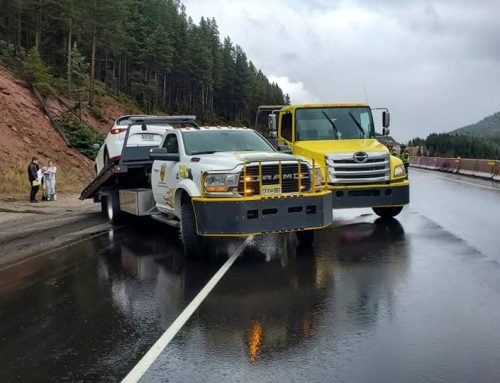
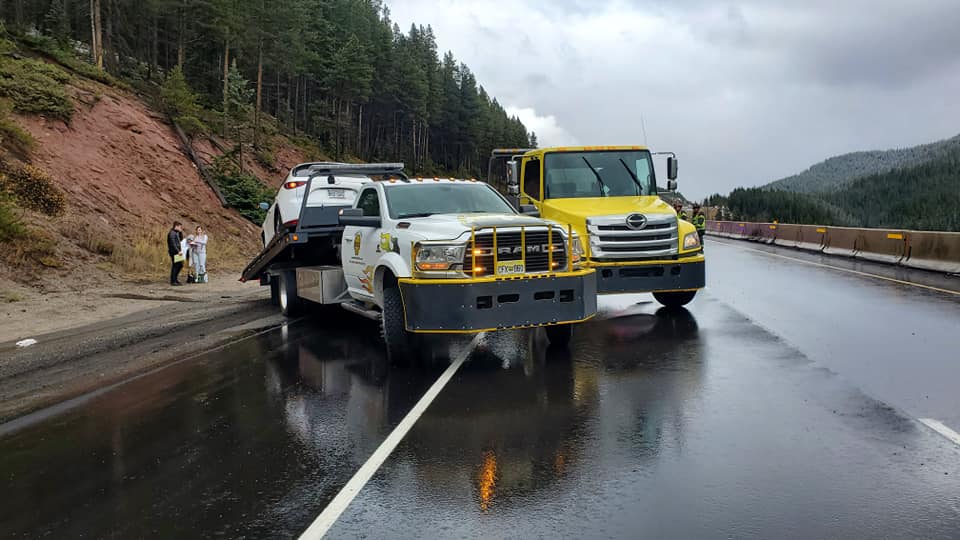
CDOT crews spent hours digging into the debris just to open a path in. Once they had one, our team and another local mountain towing company were called in to help clear the vehicles and a jackknifed, double-trailered FedEx semi that were still stuck inside the closure.

What the Recovery Looked Like
Getting to the stranded vehicles was the hard part. Crews followed CDOT’s equipment in through two to three feet of standing water, with rock, mud, and downed trees scattered across both lanes. In places, the slides had dumped seven or eight feet of debris over the retaining walls. One stretch of the canyon floor stayed flooded for nearly half a mile. It took several hours of careful, deliberate work to get every vehicle and the semi out safely — this wasn’t a routine tow, it was recovery work in conditions closer to a disaster response than a highway breakdown.
By the time the canyon reopened, CDOT crews had hauled out well over a hundred truckloads of rock and mud. It remains one of the longer safety closures I-70 has seen through the canyon, keeping the corridor shut for close to two weeks during one of the busiest travel stretches of the summer.


Where the Canyon Stands Today
The canyon has had a few close calls since — a mudslide briefly closed I-70 again in August 2023, and CDOT maintained heightened protocols requiring automatic closures anytime a Flash Flood Warning was issued for the area. But the burn scar has slowly been healing. In 2025, CDOT reassessed the wildfire and mudslide threat level for Glenwood Canyon and determined it had dropped enough that the automatic flash-flood closure protocol was no longer necessary going into the summer travel season — a real sign of how far the canyon has come back in five years.
That said, “reduced risk” doesn’t mean “no risk.” Monsoon season still brings heavy rain to the high country every summer, and CDOT continues to monitor the canyon closely. It’s part of why we tell drivers heading through Glenwood Canyon in July and August to check conditions before they go, especially during or after a heavy storm.
Why It Matters When You Call Us
Most of the calls we take are the routine ones — a flat tire on Vail Pass, a dead battery in an Avon parking lot, a breakdown on the shoulder near Edwards. But the Glenwood Canyon mudslides are a reminder that our team is built for more than that. When conditions turn into something closer to a disaster response than a standard tow, we’re one of the crews mountain communities can call on.

If you ever need towing, recovery, or roadside assistance anywhere across Eagle County — from routine breakdowns to the extreme — West Vail Towing is available 24/7.