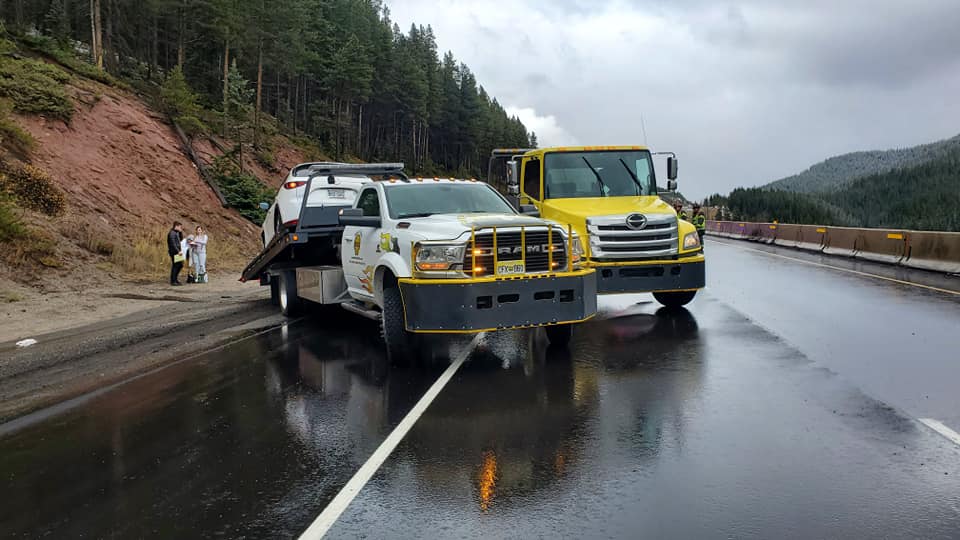
Driving through the Rocky Mountains is a breathtaking experience, but it also pushes our vehicles to their absolute limits. Navigating the steep grades of Vail Pass, enduring the severe winter weather of Eagle County, and dealing with the stop-and-go ski traffic on I-70 takes a massive toll on a car’s engine and drivetrain. When a breakdown inevitably happens, being stranded on the side of the highway is stressful enough. But what many drivers don’t realize is that the real nightmare can sometimes begin after the tow truck arrives—if the wrong towing method is used.
Here is a crucial, little-known fact that every driver navigating the Rockies should know: how your car is safely towed depends entirely on its transmission and drivetrain.
Treating a modern automatic transmission like an old-school manual during a tow can result in catastrophic, multi-thousand-dollar damage to your vehicle in a matter of miles. At West Vail Towing, we are called out to rescue stranded motorists every single day, and unfortunately, we frequently see the aftermath of improper towing jobs done by inexperienced operators.
To help you protect your investment, we have put together this comprehensive guide on why your car’s transmission matters when calling for a tow, the mechanical reasons behind it, and what you need to know to keep your vehicle safe on the roads of Eagle County, Colorado.
The Golden Rule of Towing: Protect the Drive Wheels
Before diving into the differences between transmissions, it is essential to understand the concept of “drive wheels.” Your car’s drive wheels are the specific wheels that receive power from the engine to push or pull the vehicle forward.
-
Front-Wheel Drive (FWD): The engine sends power only to the front two wheels.
-
Rear-Wheel Drive (RWD): The engine sends power only to the rear two wheels.
-
All-Wheel Drive (AWD) & 4-Wheel Drive (4WD): In these setups, the vehicle’s motor drives all four tires. Some models do this continuously, while others intelligently shift power around the moment the system detects a loss of grip.
When a car is towed with its drive wheels rolling on the pavement, the mechanical components inside the transmission are forced to spin along with the tires. How your specific transmission handles that internal spinning while the vehicle’s engine is turned off makes all the difference between a safe trip to the mechanic and a completely destroyed drivetrain.
The Anatomy of Towing an Automatic Transmission
Automatic transmissions are brilliant, highly complex pieces of engineering. Unlike manual transmissions, automatics rely heavily on hydraulic pressure to shift gears and operate. Inside an automatic transmission is a fluid pump that is driven directly by the rotation of the car’s engine. When the engine is running, this pump circulates transmission fluid throughout the system, which serves two critical purposes: it lubricates all the rapidly moving internal gears, and it acts as a coolant to dissipate heat.
The Hidden Danger
When an automatic car breaks down and the engine is off, that vital fluid pump stops working. If an inexperienced tow operator hooks up the vehicle and leaves the drive wheels on the ground, the internal parts of the transmission will be forced to spin at highway speeds as the car is dragged down I-70.
Because the engine isn’t running, those rapidly spinning gears are completely dry. Without that essential lubrication and cooling fluid, the metal-on-metal friction will quickly build up immense, localized heat. Within just a few miles, this friction will warp internal components, burn up the clutch packs, and effectively destroy the transmission. Replacing a burned-up automatic transmission can easily cost between $3,000 and $7,000, depending on your vehicle.
The Solution
-
Flatbed Towing: This is the safest, most foolproof, and highly preferred method for automatic vehicles. The entire vehicle is winched up onto a flatbed truck, meaning none of the car’s wheels touch the ground.
-
Wheel-Lift Towing: If a flatbed is unavailable or cannot fit into a tight space (like a low-clearance parking garage in Vail), a tow operator can use a wheel-lift. This device lifts the drive wheels completely off the ground, allowing the car to roll safely on its non-drive wheels.
Towing a Manual Transmission: More Forgiving, But Still Risky
Manual transmissions (stick shifts) are mechanically simpler than automatics. Instead of using a motorized pump to move hydraulic fluid around, manual gearboxes use a simpler mechanical design. The gears inside a manual transmission sit partially submerged in a bath of gear oil. The movement of the gears physically scoops the oil from the bottom of the case and flings it onto the surrounding components to keep everything lubricated.
The Danger
Because of this mechanical design, manual transmissions are much more forgiving when the engine is off. However, they are not immune to user error. If a manual car is towed with its drive wheels on the ground but the gear shifter is accidentally left in gear (1st, 2nd, reverse, etc.), the turning wheels will force the engine to turn over. This will cause violent resistance, potentially destroying the transmission linkage, snapping axles, or causing severe internal engine damage.
The Solution
-
Neutral is the Key: A manual car can usually be towed safely with its drive wheels on the ground—using a standard wheel-lift or even a traditional tow bar—provided that the transmission is shifted entirely into neutral and the parking brake is fully disengaged.
-
Flatbed is Still King: Even though a manual car can safely roll on its drive wheels, a flatbed tow remains the gold standard in the towing industry. Lifting the entire car off the ground prevents unnecessary wear and tear on your tires, suspension components, and wheel bearings, which is especially important on the pothole-ridden roads we often see after a harsh Colorado winter.
The Colorado Factor: Navigating AWD and 4WD Vehicles
Here in Eagle County, AWD and 4WD vehicles like Subarus, Jeeps, Toyota Tacomas, and Audi Quattros dominate the roads. These drivetrains add a massive layer of complexity to the towing process.
Because power can be sent to all four wheels, all four wheels are technically drive wheels. Furthermore, these vehicles utilize center differentials and transfer cases to link the front and rear axles. If you lift just the front wheels of an AWD Subaru and try to tow it, the rear wheels will spin, which forces the center differential to rapidly heat up as it tries to reconcile the difference in speed between the front and rear axles. This will cause the center differential to bind and eventually shatter.
For AWD and 4WD vehicles, a flatbed tow truck is an absolute, non-negotiable requirement. If a flatbed cannot physically access the vehicle, the tow truck operator must carry and deploy “tow dollies”—specialized auxiliary wheels that lift the remaining grounded tires off the pavement so the car can be towed safely without a single tire rolling on the asphalt.
Why Choosing the Right Towing Company Matters
When you are stranded on the shoulder of Vail Pass with semi-trucks flying by in a blizzard, you are in a vulnerable position. You shouldn’t have to be the mechanical expert double-checking the tow truck operator’s methods—that is our job here at West Vail Towing.
Not all towing services take the time to properly assess a vehicle’s drivetrain before aggressively hooking it up and dragging it away. A professional, experienced towing company will always ask you specific questions about your vehicle’s make, model, year, and transmission type before they even dispatch a truck to your location. At West Vail Towing, we take this pre-dispatch assessment very seriously. We always arrive prepared with the exact right equipment for your specific car—whether that means sending a heavy-duty flatbed for your AWD SUV, or bringing a wheel-lift equipped with dollies to extract your vehicle safely from a tight snowbank.
What to Do When You Need a Tow in Eagle County
If you find yourself broken down, keep these tips in mind when you call for help:
-
Know Your Vehicle: Be ready to tell the dispatcher your exact make, model, and year.
-
Specify the Drivetrain: Tell them immediately if your car is Automatic or Manual, and if it is FWD, RWD, AWD, or 4WD.
-
Describe Your Location: Give mile markers on I-70, specify if you are on an incline, and note the road conditions (ice, mud, deep snow).
-
Demand the Right Equipment: Never let a tow truck operator drag your AWD or automatic vehicle by its drive wheels, no matter how much of a hurry they are in.
The Bottom Line: Knowledge is power, and knowing how your car needs to be towed can save you thousands of dollars in easily avoidable mechanical damage.
Save West Vail Towing’s number in your phone today! If you ever find yourself stranded on Vail Pass, I-70, or anywhere in Eagle County, Colorado, you can trust our highly trained, experienced team to dispatch the right truck and protect your vehicle every step of the way.